Iran is a country of
dramatic contrasts. Its scenery ranges from snow-clad
mountains to vast inhospitable deserts punctuated
by attractive oasis towns. Its cities and ancient
sites, built by a society which embraced the pursuit
of knowledge and art, reveal a deep and rich history.
Some of the most exquisite examples of Middle Eastern
design and architecture are to be found in Iran: the
magnificent ruins of Persepolis, the dazzling Islamic
centres at Isfahan and Shiraz, and beautifully-crafted
gardens set in desert wastes. The rich bazaars, the
chador-clad women and the ancient tradition of hospitality
never fail to surprise and impress the visitor, in
a country which, undeservedly, sees few tourists.
The capital Tehran is
essentially a modern city, but the best of the old
has been preserved. The Shahid Motahari Mosque has
eight minarets, from which the city can be viewed.
The Bazaar (open every day except Friday and religious
holidays) is one of the worlds' largest; another bazaar,
catering mainly for local communities, can be found
in the Tajrish suburb. Located in the north of the
capital, an endless maze of vaulted alleys, everything
from fine carpets to silver- and copperware to exotic
aromatic spices can be found here.
Tehran has several good
museums, including the Abgineh Museum of Iranian Pottery;
the Rea Abbasi Museum, housing a rare collection of
Iranian calligraphy and paintings; the National Museum
of Iran (Iran Bastan Museum), which displays mostly
archaeological and anthropological exhibits; the Rassam
Cultural and Art Foundation of Carpet, which includes
a carpet museum and carpet weaving school; the Carpet
Museum, whose oldest carpet is 450 years old; and
the Anthropological Museums in Golestan Place and
Saad Abad. Iran's capital also has a number of cultural
centres (including Azadi, Bahman and Khavaran) as
well as a National Library, a City Theatre, a Zoo
and a University.
Excursions
The Alborz mountain chain is a popular destination
for excursions from Tehran. There are numerous mountain
resorts offering cable car facilities as well as skiing
slopes (the season running from January to March).
Within easy reach of Tehran are the towns of Rey,
Varamin, Qazvin and Shemshak, which have preserved
much of their original character.
Northwestern Iran
The country's second-largest city, Tabriz, has a ruined
but restored fine blue mosque built in 1465. The covered
Qaisariyeh Bazaar dates back to the 15th century.
About 22km (14 miles) from the salt lake is the town
of Uromieh, which claims to be the birthplace of Zoroaster.
Other towns worth visiting include Ardabil, Astara,
Bandar-e Anzali and Rasht.
The Golden Triangle
The Golden Triangle is the name popularly given to
the region enclosed by the ancient cities of Hamadan,
Kermanshah and Khorramabad. This is a part of Iran
which is particularly rich in historical associations;
for many centuries the Silk Road passed through the
pleasant rolling countryside of the region, and there
are several indications of settlements dating back
over 6000 years. Hamadan was the summer capital of
the Persian Emperors, although one of the few easily
visible signs of the city's antiquity is the Stone
Lion, dating back to the time of Alexander the Great.
Kermanshah is a good base for visiting the Taghe Bostan
Grottoes, which have several excellent bas-relief
carvings. The site of the Seleucid Temple of Artemis
is in Kangavar; it consists of massive fallen columns
and is now being reconstructed.
Esfahan
Esfahan is the former capital of Persia and has been
designated by UNESCO as a World Heritage Site. The
city's most remarkable feature is its magnificent
central square which is roughly seven times larger
than San Marco in Venice. The mosques, palaces, bridges
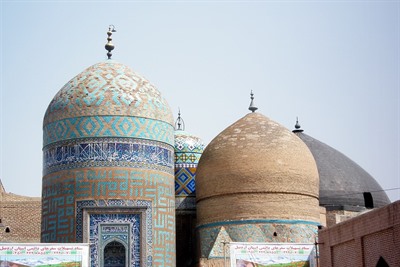
and gardens also deserve a visit. The Friday Mosque
(Masjid-e Jomeh) is one of Iran's finest buildings.
The Shaikh Lotfullah Mosque is famous for the stalactite
effect of its northern entrance. There are also several
good bazaars.
Elsewhere
Shiraz is the capital of the Fars Province, and another
of the country's ancient cities. Several of the buildings
date back to the ninth century, and there are many
excellent parks and gardens. About 50km (30 miles)
away is Persepolis, also on the UNESCO World Heritage
list, and famous for the Ceremonial Seat of Darius,
built on an enormous platform carved out of the Kuhe
Rahmat. Another UNESCO-listed archaeological site
can be found at Changha Zanbil, 40km (25 miles) southeast
of Susa.
Khorasan is a large province in the
east where a great revival of learning occurred in
the early Middle Ages. Mashhad, a former trading post
on the Silk Road, is the capital of the region.
The city of Kerman in the southern desert
region has several stunning mosques and a ruined citadel,
although visitors are advised to exercise caution
and only travel on tours organized through Iranian
government-approved tourist organizations.